How long does a cartilage piercing take to heal? 5 critical mistakes guests make, and the method we use to help avoid inflammation
A sharp, stabbing cramp shoots through your temple, and because of a migraine that just won’t stop, you lie helplessly in a dark room waiting for the third strong painkiller to finally work. Constant headaches, anxiety or sleep problems have completely used up your everyday energy, and traditional methods have only brought temporary relief. When, searching the internet, you come across the jewellery placed in the ear cartilage that our guests like, a glimmer of hope appears, but reading the forums you are immediately frightened by the horror stories. Images of swollen, overgranulated ears inflamed for months come to mind, and you rightly ask yourself: is it worth the risk?
I have good news: the regeneration of jewellery pierced into the ear cartilage is not a game of chance if we follow a strict healthcare protocol from the very beginning.
What does the internet say about the regeneration of an ear cartilage piercing?
If you look at the first few organic results on Google, most articles and tattoo studio blogs deal with the topic using standard advice. They say: clean it with salt water, don’t sleep on it, and wait patiently for 3–6 months, because cartilage tissue regenerates slowly. However, this approach is superficial and leaves out exactly the essentials.
Ear cartilage is not like the soft earlobe. There are no classic blood vessels here.
Cartilage tissue is nourished by diffusion, from the surrounding tissues. That is why cell regeneration takes longer than average, and that is why the tissue is extremely sensitive to external influences. If the piercing procedure is not sterile, or if the jewellery sits at the wrong angle, the body will react with constant inflammation. That is exactly why at Medical Piercing we see this process not simply as fashion, but as the targeted stimulation of reflex points.
Why targeted point stimulation does not belong in a tattoo studio
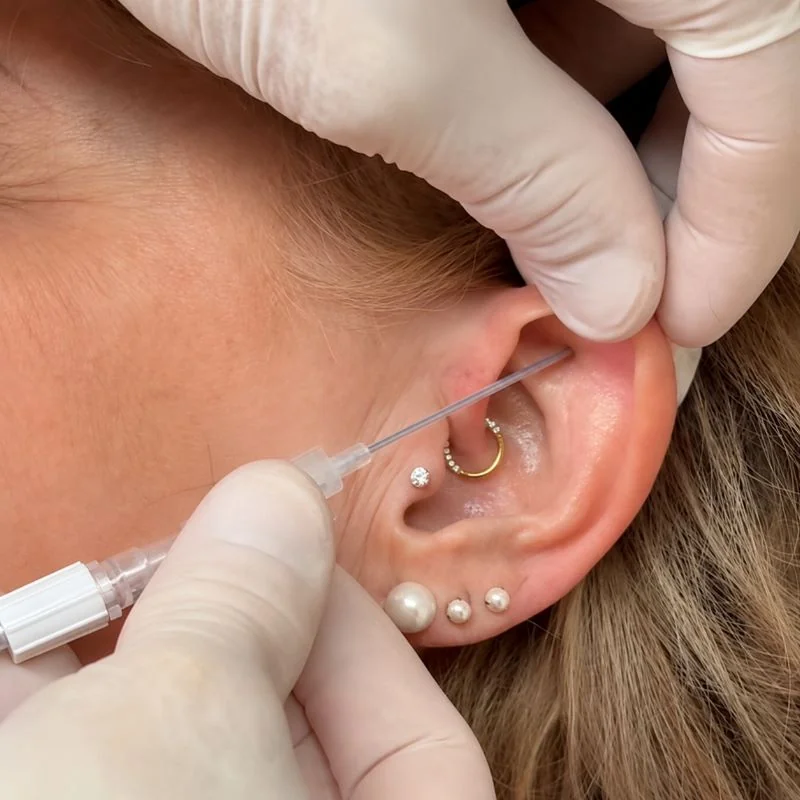
Many people make the mistake of popping into a dark studio dealing with tattoos and body jewellery, where they have their ear pierced amid loud music and tattoos being done one after another. Although an ear-piercing gun or a simple piercing needle may be suitable for inserting fashion jewellery, reaching a reflex zone requires a completely different approach.
This is not just fashion. It is a process that supports wellbeing. With us, safety comes first.
Our team is not made up of tattoo artists or piercers. We are ear acupuncture specialists with healthcare experience . This difference defines our entire workflow. With us there is no rushing, no unsterilised instruments and no guesswork.
The healthcare protocol: this is how the piercing and support for regeneration take place
Based on our guests’ feedback, the period after the insertion of ear cartilage jewellery becomes problem-free for many because we carry out the most important steps before the piercing. We don’t “just” stick a needle into your ear.
Detailed assessment before the piercing
Before we touch any instrument, we discuss your complaints in detail and examine the anatomy of your ear. Using a special point-finder device, we locate with millimetre precision the ear acupuncture area – the zone known by many in everyday language as the ShenMen or migraine point – from the stimulation of which our guests have reported positive experiences. It is important to know that the sensitivity of the reflex points and the effect of wearing the jewellery are completely individual for every body, so no guaranteed result can be promised.
Strictly sterile, professional environment
At the Medical Piercing studios (in Budapest and in 11 large regional cities) you are welcomed in a professional and sterile environment that meets the strictest public health and hygiene regulations. We work exclusively with single-use, sterile medical needles. The jewellery is made of premium-quality, tissue-friendly titanium or medical-grade metal, which contains no nickel, thus minimising the chance of allergic reactions and tissue irritation.
The importance of follow-up
Most studios let go of your hand after payment. With us, the process does not end when you leave. We provide follow-up: if you have any questions or doubts during the healing phase, you can turn to our specialists for help straight away.
Cartilage piercing healing: how long does it really take?
Due to the characteristics of cartilage tissue, complete cell regeneration varies from person to person and usually takes 2–6 months . However, based on our guests’ experience, the critical, initial tight and sensitive period subsides in the first 2–3 weeks if you follow the professional instructions.
The stages of the process based on our guests’ feedback:
Period
What happens to the ear cartilage?
Expert to-do
Days 1–7
Mild swelling, redness, throbbing.
Strict disinfection, avoiding turning the jewellery.
Weeks 2–4
The outer wound closes, the tightness stops.
Care when getting dressed, protecting the ear while sleeping.
Months 2–6
The inner cartilage channel stabilises.
Keeping the jewellery clean, achieving complete regeneration.
The difference between the ShenMen and the migraine zone in terms of healing
At our studios in Budapest and around the country we are often asked whether different points of the ear heal differently. Although both pieces of jewellery go into the cartilage part of the ear, their regeneration may differ minimally due to their location. The ShenMen point lies in the triangular groove in the upper part of the ear (fossa triangularis), where the cartilage is relatively thinner. According to our guests’ feedback, this area is more sensitive to getting dressed in the first days, as clothing or hair can catch on it more easily.
The jewellery placed in the inner cartilage fold of the ear, in the area above the ear canal, is a different story.
This area is better protected against external mechanical effects, and combs or scarves catch on it less often. At the same time, since it lies deeper, cleaning and disinfecting it requires more attention in the first weeks. Our ear acupuncture specialists show you on the spot exactly how to use a cotton bud correctly so that both sides of the cartilage channel stay clean.
What should you do if a small lump (so-called overgranulation) appears next to the cartilage?
During the healing of an ear cartilage piercing, one of the most common frightening phenomena is the appearance of a tiny reddish or skin-coloured lump right next to the piercing point. In everyday language this is called “proud flesh”, but in professional terms it is most often hypertrophic scar tissue or an irritation granuloma.
This lump does not mean an infection; it is the body’s reaction to continuous irritation.
Behind the formation of the lump there is almost always mechanical trauma: if the guest lay on their ear while sleeping, knocked it, or moved the jewellery more than necessary. The good news is that this condition is not permanent. If you experience this, as part of our follow-up protocol you can consult our specialists straight away, who will help the scar tissue recede with specific local care suggestions.
What jewellery should you choose for the first period? The advantages of titanium and medical-grade metal
The chances of cartilage tissue healing are fundamentally determined by the material that comes into contact with the fresh wound. Many people make the mistake of wanting to wear sparkly, costume or silver jewellery straight away. This is forbidden in the first months.
During the healing phase, only biocompatible materials may remain in the ear.
At the Medical Piercing studios we use premium titanium (G23 Ti) or premium-quality medical-grade metal (316L) jewellery by default. Titanium contains no nickel, is completely hypoallergenic, and its weight is extremely low, so it does not pull the tissue down. The extremely smooth surface of medical-grade metal prevents wound secretion from crusting onto the jewellery bar, which makes daily cleaning much easier.
4 critical mistakes you must avoid for problem-free regeneration
The classic internet results often forget to mention the small everyday movements that can lead to problems. Here are the most common mistakes, which we have collected based on the experience of the women who come to us, and which you absolutely must avoid:
1. Constantly touching the wound and turning the jewellery
The old school taught that the piercing has to be turned so that it doesn’t “stick” into the wound. This is a huge misconception. With every turn you tear the newly forming cell layer, introduce germs into the cartilage channel and increase the risk of inflammation. Don’t touch it! Leave it alone!
2. Hairspray, perfume and make-up around the ear
During everyday getting ready, the fine mist of hairspray or perfume can settle on the fresh wound. These chemicals cause aggressive irritation. We advise our guests to cover their ears when using cosmetics in the first weeks.
3. Sleeping on the fresh jewellery
If you lie on your ear, the jewellery bar shifts and starts to strain the cartilage tissue from the inside. This is not only painful but can lead to asymmetrical healing and the appearance of small lumps. The solution? Use a travel pillow (neck pillow), and when sleeping, place your ear in the hole in the middle of the pillow!
4. Swimming pools, saunas and sunbeds in the first weeks
The chlorine and bacteria in shared water are the greatest enemies of a fresh cartilage channel. The increased blood flow caused by the sauna can intensify throbbing and swelling. For your safety, avoid these places in the first month!
Why do responsible women choose Medical Piercing?
When, as a woman between 30 and 55, you decide to give natural, medication-free methods a try for better wellbeing, you cannot afford the risk of infection. You don’t want another problem, but a solution to the existing one.
Our studio network was created precisely to lift this activity out of the subculture and put it in a clean, transparent and safe setting.
- 12 available locations: You don’t need to travel for hours. We are in Budapest and in 11 large regional cities: Kecskemét, Keszthely, Miskolc, Sopron, Szeged, Békéscsaba, Debrecen, Nagykanizsa, Nyíregyháza, Zalaegerszeg and Pécs.
- Expertise before fashion: Our specialists with a healthcare background know exactly how the body reacts to stimulation.
- Proven satisfaction: Based on our internal satisfaction questionnaires and the feedback we receive, the overwhelming majority of our guests report that in the weeks following the piercing they experienced a significant improvement in their quality of life in their everyday lives, and that the regeneration period was much smoother than they had expected.
Take the first step towards more balanced everyday life!
Don’t let recurring headaches or tension control your life, and don’t be afraid of having ear cartilage jewellery inserted either. If you entrust yourself to expert hands, the regeneration process is safe and well controlled.
Visit the medicalpiercing.hu website, where on a transparent online interface you can immediately see all our free appointments in real time, in Budapest and in our 11 large regional cities alike.
Choose the location closest to you, book an appointment online in a few clicks, and we look forward to welcoming you for a safe, professional assessment and the piercing of the targeted points!