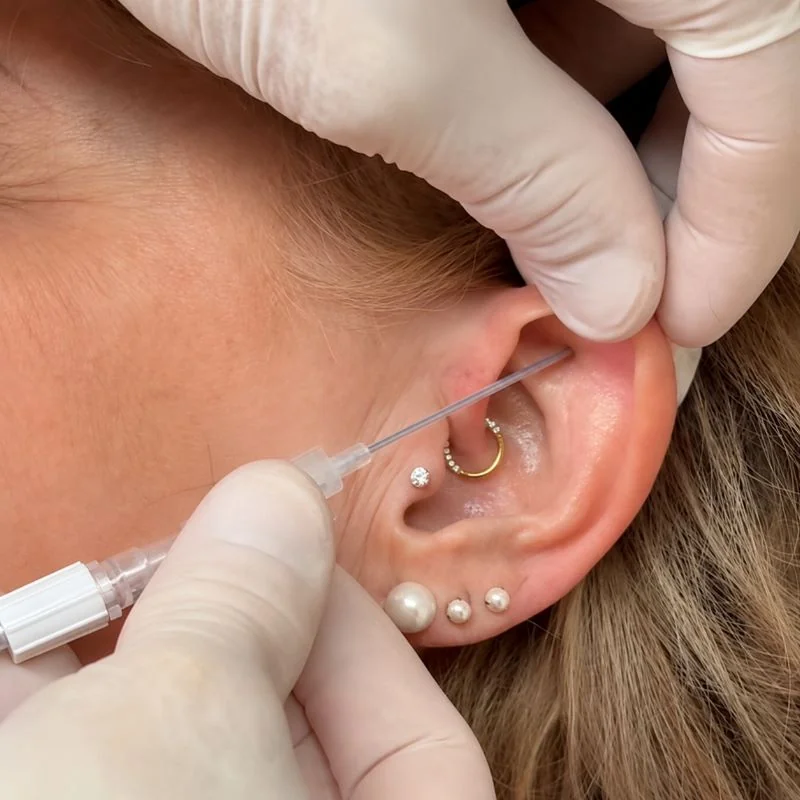
Daith piercing research: vagus nerve stimulation and migraine treatment
Summary of the Daith piercing research
After reports of the effect of the Daith piercing (DP) on migraine appeared widely on social media in 2015, thousands of migraine patients visited piercing studios in the hope of treating their migraines. Despite this, little medical research has been done on the topic. Our aim was to examine, in two series, patients at a London migraine clinic who wear a Daith piercing.
In the First Series, of 42 consecutive patients, 30 reported an improvement in their headaches 1–4 months after the piercing, on average a threefold increase in the average number of symptom-free days. The improvement persisted in the long term in the 11 patients we reached at the 12-month follow-up. The reduction in headache and visual discomfort often occurred immediately after the DP, which is why we also examined the change in visual complaints before and after the piercing. We examined this by having participants look at gratings made of parallel lines, which are known to have a negative effect on migraine. The reduction in discomfort caused by visual perception after the piercing was considerably greater in patients who later also reported an improvement in their migraine.
In the Second Series, before the piercing, as pre-treatment, 115 patients received temporary stimulation with fine needles at two particular cartilage sites of the ear, and these were compared. The first was at the antitragus (an area supplied by the main nerve of the ear, which has no connection to the vagus), the second at the inner Daith point of the ear, on the lower surface of the crus helicis (an area supplied by the vagus nerve). Stimulating the antitragus produced no effect, whereas stimulation of the Daith point measurably reduced visual discomfort and other symptoms, such as headache, within as little as one minute. In about three quarters of the patients the symptoms returned within the same time interval as soon as the needle was removed. After the therapeutic piercing, a further significant reduction was experienced in both the visual problems and other symptoms.
These results strongly suggest an effect of vagus nerve stimulation, although this still requires further research and confirmation. We concluded that DP may potentially be a simple, inexpensive and effective treatment for some patients with severe migraine.
Glossary
- ABVN Auricular branch of the vagus nerve
- ATN Auriculotemporal nerve (a branch of the trigeminal nerve)
- CNxx xxth cranial nerve
- DP Daith ear piercing
- GAN Great auricular nerve
- LON Lesser occipital nerve
- MEG Magnetoencephalography
- VNS Vagus nerve stimulation
- tVNS transcutaneous electrical VNS
- sVNS sustained percutaneous VNS
Introduction
Having just become popular in 1992 as a fashionable body jewel, wearers of the Daith piercing (DP) soon reported incidental improvements in their migraine. At first, reports of reduced migraine complaints spread slowly, then in 2015 wearing a DP spread virally after Dr Thomas Cohn, practising in the United States, published an article on his website about the reduction of headache cases. Since then, thousands of migraine sufferers have had a DP to treat their migraine. At the end of 2016, when we first heard about these reports, any evidence of its effectiveness was limited to a few amateur surveys. We analysed one such survey in detail, and the correlation between the data suggested that further professional surveys would be justified. Since May 2017 we have carried out four internet surveys of more than 4,500 migraine patients who had a DP (of whom more than 850 had had migraine for more than 10 years and had been pierced more than 12 months earlier), and all of them confirmed the reports of migraine reduction, as had also emerged from the original amateur survey (Blatchley et al., 2017).
So far, the only published work on the Daith earring discusses the case of just one patient, and it also recommends further research (Rizzo et al., 2017). Nevertheless, there is also a physiological argument that DP may have an effect on migraine. The DP pierces the crus helicis, a cartilage surface at the upper edge of the ear canal, which is supplied by the auricular branch of the vagus nerve (ABVN) (see Figures 1b and 1c). Invasive vagus nerve stimulation (iVNS) is an established treatment for both migraine and epilepsy, and significant research has been done on non-invasive transcutaneous electrical stimulation via the ABVN (Gu et al., 2018; Tassorelli et al., 2018). Unlike transcutaneous electrical devices – which are used intermittently – the piercing stimulates this area constantly, so any effect on the ABVN may well persist in the long term. For this reason we saw the need for a detailed review of the effects of DP.
At that point we began offering the option of DP to migraine patients who had been researching migraine treatment options on the internet. After receiving it, to our great surprise, most patients reported a significant and immediate improvement in their symptoms, such as a reduction in “brain fog”, neck pain, jaw pain and visual discomfort, so not only relief of headache. Many reported that their complaints stopped completely, and this was later often observed in patients’ reactions immediately after the piercing.
It is well known that gratings made of contrasting parallel lines generally intensify symptoms in migraine sufferers (Wilkins et al., 1984; Marcus and Soso, 1989). From March 2018 we began checking the changes in visual discomfort caused by gratings before and after DP. The reduction in visual complaints after the piercing was often clearly observable during the treatment (see the description of the First Series below), but we were concerned that this might simply be a placebo reaction, or that the pain caused by the piercing had merely distracted their attention from their actual symptoms. It is important to note that the reaction to the pain experienced during the piercing varied greatly. We therefore checked the effects with a temporary diagnostic stimulation performed with a fine needle, which caused minimal or no pain. In many patients we found that stimulating the Daith piercing point with a needle immediately reduced the discomfort that looking at gratings could generate, and other symptoms (headache, “brain fog”, etc.) also eased. However, all of these returned when we removed the needle. As a control, we gave similar temporary stimulation to an area of the ear that is not supplied by the ABVN and which we assumed to be inactive (see the description of the Second Series below).
We report the results of these two series of studies, whose participants attended the London migraine clinic and requested a DP for their migraine.
First Series
Methods
From March 2018 we began collecting data from a questionnaire series of 40 consecutive patients (39 women) who had suffered from headaches for a long time. These participants sought out DP through social media and the internet. First they completed a detailed headache questionnaire, then, after a detailed explanation of the procedure, they signed the consent form.
Piercing
The DP passes through the cartilage of the crus helicis, from the cymba conchae to its lower surface near the top of the auditory meatus, see Figures 1a and 1b.
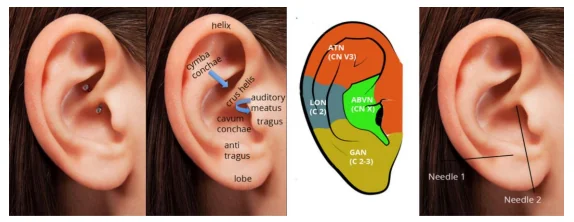
Figure 1 a. Daith piercing; b. The anatomy of the ear and its innervation. ABVN – auricular branch of the vagus nerve (CN10); ATN – auriculotemporal nerve (from CN5); GAN – great auricular nerve (from the cervical nerves); LON – lesser occipital nerve (from the cervical nerves). d. Acupuncture needle positions in Series 2.
The first step was disinfecting the skin with 70% alcohol. A sharp, disposable 18-gauge needle was used to pierce the skin on the upper surface of the crus helicis. The needle then passed through the cartilage to come out on the lower surface of the ear. The needle was used to insert the jewellery, which then remained in the ear. The jewellery itself may be a closed ring or a curved bar with metal retaining balls screwed on at the top and bottom. We did not use medical stainless steel because of its nickel content; instead we used 100% titanium jewellery. All equipment and jewellery were sterilised in a vacuum autoclave, and the needle and guide were single-use in every case.
Performing the Daith piercing requires a precise technique, so we worked with a piercer with many years of experience. Surprisingly, the piercing was often painless, and in patients who did experience pain, it was of short duration.
Assessment of visual discomfort when looking at gratings.
The visual discomfort caused by gratings was assessed before the DP and immediately afterwards. For this we used an image of three gratings with different line densities, then another consisting of 10 high-contrast gratings, all with the same line density. The line density in each grating was expressed as spatial frequency measured in cycles (cpd – cycles per degree). One cycle means a pair of black and white lines of equal width. It has previously been shown that a spatial frequency of about 3 cpd is the one most capable of triggering complaints (Wilkins et al., 1984).
All patterns were circular and subtended an angle of 9 degrees at a viewing distance of 0.6 m. The room lighting was 150 lux. Patients looked at each pattern for 1–2 seconds and had to mark the degree of complaints experienced on a 6-point scale: “none”, “noticeable”, “mild”, “moderate”, “severe”, “unbearable”.
We also examined a control group of 130 patients who had no medical history suggesting headache and had not received a DP (89 men, 41 women). Their visual discomfort was examined with the same gratings during a routine eye check, under the same lighting conditions.
Follow-up details
We followed up the patients via a link sent by e-mail, which included an online questionnaire with questions about headache frequency, severity, associated symptoms, medication use, etc. Follow-up took place from 31 May 2018, 1–4 months after the DP, and from 20 May 2019, 12 or more months after the DP.
Headache assessment
Migraine, headache and other symptoms were assessed in detail. Patients were asked about the frequency of migraine/severe headache, other non-migraine headaches, and completely symptom-free days, both initially and during follow-up. During follow-up they were also asked: “Overall, how has the Daith piercing changed your migraine/severe headaches?”, with the answer options: “much worse”, “a little worse”, “I have not noticed any change”, “a little better”, “significantly better” and “I no longer have them”.
Results of the First Series
At the 1–4 month point we were able to follow up 42 of the 57 participants (73%). We report on these 42 patients, who received a DP between March and May 2018. On average they had suffered from headaches for 16 years (minimum 1 year, maximum more than 20 years). Their headaches were frequent (on average seven symptom-free days a month) and severe (preventing work in 80%). 36% of the patients experienced aura.
Immediate response to the gratings
Figure 2 shows the average result for the 42 migraine patients before and immediately after DP for the three-grating test, in which the gratings differed in spatial frequency (left panel), and later for ten gratings increasing in contrast (right panel). The average rated visual discomfort from all patterns was significantly greater before DP than after it (t(41)=10.1, p<.0001).
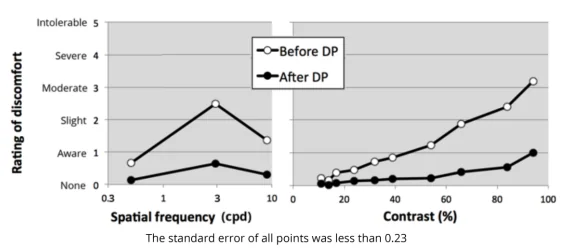
Figure 2: Ratings of visual discomfort caused by gratings before and after DP. Left panel: high-contrast gratings with spatial frequencies of 0.5, 3 and 9 cpd. Right panel: gratings of variable contrast with a spatial frequency of 3 cpd. Separate curves show the ratings before and after DP.
In the control group of 130 people (89 men, 41 women) with no medical history suggesting migraine, looking at the gratings caused no discomfort for 125. Four patients (3 women) experienced “mild” discomfort, and only one man had “moderate” discomfort.
Clinical changes at the 1–4 month follow-up
For the group as a whole there was a large and significant reduction in the number of migraine days and an increase in the number of symptom-free days (Wilcoxon tests, z>4.19, p<.0001, two-tailed, both measures). In addition, the severity of migraine also decreased significantly (t(36)=7.05, p<.0001).
This result was further strengthened when we divided the whole group into further groups based on the answers to the question asked during follow-up: “Overall, how has the Daith piercing changed your migraine/severe headaches?”. The answer options are shown in the first column of Table 1; the table also includes the average monthly numbers of migraine days and symptom-free days at the consultation before DP and at follow-up. The patients’ subjective assessment of the change in their migraine matches the change experienced in migraine and symptom-free days.
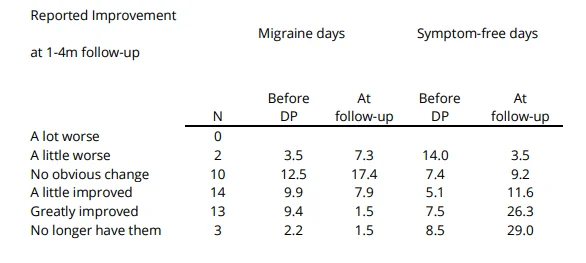
Table 1: Average migraine days and symptom-free days in the month before DP and at follow-up, grouped by the overall improvement reported at follow-up.
As can be seen from Table 1, individuals who stated that their headaches had “greatly improved” showed a marked reduction in migraine days and a significant increase in the number of symptom-free days. These numbers were less significant for those who reported a “slight improvement”, and for those who “noticed no change” there was little difference between the period before DP and the follow-up period.
The relationship between the response to the gratings and later clinical results
For the group as a whole, there was a correlation between the reduction in visual discomfort rated after DP insertion and the later change in migraine days at 1–4 months (rho=0.31, p<.05), as well as symptom-free days (rho=0.32, p<.05). This development can similarly be illustrated by partially breaking down the group according to the overall improvement reported at 1–4 months, see Table 2.
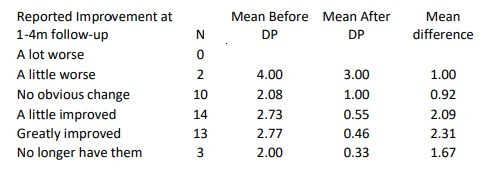
Table 2: Average discomfort before and after DP, grouped by overall improvement
The long-term effects of DP
In the 12th month after DP we were able to contact only 11 of the 30 patients who had reported improvement at 1–4 months (we did not keep in touch with the 12 patients who showed no improvement). Of the 11 patients, 5 also reported that the “effect has not yet started to fade”. See the results in Figure 3.
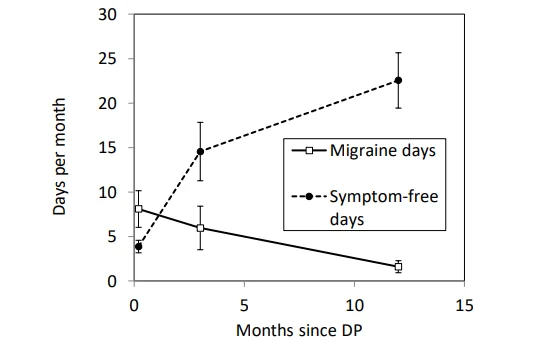
Figure 3 Data of the 11 patients who had previously reported improvement in the 1–4 month questionnaire (8/11 reported slight improvement and 3/11 great improvement). In the 12-month questionnaire, 1 migraine had stopped, 9 patients reported great improvement, 1 slight improvement and 1 noticed no change. The reported migraine days do not include mild “other headache” days.
Interim discussion: Series 1
The patients in Series 1 struggled with frequent and severe headaches. At the first follow-up, more than half of the patients reported improvement, and in 38% of them this improvement was marked. In the small sample we followed up after one year, 9 out of 11 still reported significant improvement. Most migraine patients experienced visual discomfort caused by the grating patterns, and the average degree of reduction brought about by DP predicted the improvement in headache not only at the 1–4 month follow-up but also at 12 months.
Series 2
In order to explore the possibility of a placebo response in the results of Series 1, we carried out temporary diagnostic stimulation on the ear with small needles before the piercing in 115 patients (treated from March to December 2019). This allowed us to compare the immediate effects of DP with stimulation of both the Daith point and an inactive point.
Methods
The general procedures regarding the first questionnaire, the consent form and the piercing method remained the same as in Series 1. In Series 2 we added temporary stimulation with fine 31G, 0.25 mm diameter needles, consecutively at the two points shown in Figure 1/d: Needle 1 in the area of the antitragus, which is not innervated by the ABVN, and Needle 2 at the lower Daith piercing point on the lower surface of the crus helicis, an area supplied by the ABVN. We explained to the participants that we would insert two diagnostic needles one after the other in different places to measure the nerve response, and then asked for their consent to this procedure. We took care not to explain the specific significance of the needles. The needles were passed through the epidermis to the cartilage. In all patients, inserting the needle caused minimal or no discomfort. Before insertion, the area was disinfected with 70% alcohol.
We asked the patients to look at the grating patterns and rate their complaints on four occasions: initially, while the needles were inserted, and again after the DP. We also asked them to report if they noticed any change after the needle was inserted and also after it was withdrawn.
Results of Series 2
At the first examination, patients reported on average 8.2 migraine days and 7.5 symptom-free days a month. The migraine headaches were so severe that in 75% of cases they prevented work. In 59% of cases they also reported aura symptoms.
Change in visual complaints
The ratings of visual discomfort before Needle 1, during Needle 1, during Needle 2 and after DP are shown on separate curves in Figure 4. Needle 1 (in the antitragus, see Figures 1b and 1d) produced no change. The average values before the insertion of the first and second needles were 1.34 and 1.35 respectively; t(114)=1.06, p=.29. In contrast, Needle 2 at the Daith point significantly reduced the degree of discomfort (average rating 1.00, t(112)=8.04, p<.0001). A further significant reduction followed from the DP (average rating 0.54, t(113)=11.61, p<.0001).
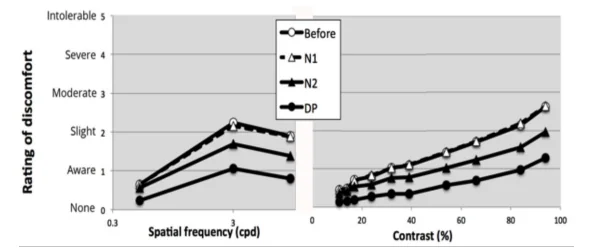
Figure 4: Ratings of visual complaints caused by gratings. Left panel: high-contrast gratings with spatial frequencies of 0.5, 3 and 9 cpd. Right panel: gratings of variable contrast with a spatial frequency of 3 cpd. The standard error at every point was less than 0.23. Separate curves show the ratings before needle stimulation, during stimulation with needle 1 (N1), during stimulation with needle 2 (N2) and after DP. (The “before” and “N1” curves almost overlap.) The standard error at every point was less than 0.17.
Change in symptoms
Patients were asked about the effect of the needle stimulation on their symptoms and whether the symptoms returned after the needle was removed. Table 3 contains the reported symptoms and the number of patients reporting them before DP. It also shows the change in symptoms after the needle was removed.
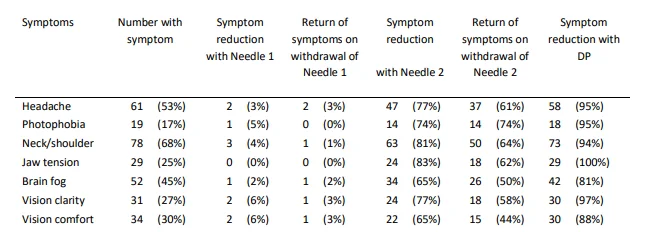
Table 3: Symptoms reported before DP, and the effect on these symptoms after insertion and removal of needle 1 (antitragus) and needle 2 (lower Daith point), and after DP.
As can be seen from Table 3, Needle 1 had little effect on any symptom, while Needle 2 reduced most symptoms, but only when it was exactly in place. DP reduced almost all symptoms.
Discussion
At present, medical research on the Daith Piercing (DP) in migraine concerns only one case, despite the fact that many thousands of migraine sufferers have visited piercing studios over the past 20 years to treat their migraine. Two initial questions need to be clarified: 1. Does DP have a central effect that goes beyond the placebo effect? 2. If so, how effective is it in reducing migraine and how long does this effect last?
Our research is a review of treatment with DP, not a placebo-controlled study. DP is a visible, tangible therapeutic device, so it would be clear to participants in every case whether or not they had received a placebo treatment. Effective study design requires initial data. At present there are no such data, so we chose a gradual procedure to establish whether or not the reported responses are entirely due to the placebo effect, and whether further research is justified.
Our research supports the hypothesis that in some patients DP has a significant and long-term central effect on migraine, probably as a result of stimulating the vagus nerve. Although we do not rule out a placebo effect, it would be difficult to explain the results solely as a placebo effect for the following reasons:
1. It is a known fact that black-and-white parallel line patterns are disturbing for migraine sufferers. The reactions before DP were entirely predictable when both the spatial frequency and the contrast of the patterns were varied. After DP this discomfort consistently showed a similar but reduced response. Other subjective symptoms also decreased, and the patients’ experience was evident. The degree of change after DP was remarkable and statistically highly significant.
2. Inserting acupuncture needle 2 (Needle 2) similarly caused a consistent (though less marked) reduction in visual discomfort and other symptoms, even though inserting the needle caused minimal or no pain. These changes partly indicate a non-placebo response, but the piercing or taking the patient’s expectations into account cannot yet be ruled out as a possible explanation.
3. After Needle 2 was removed, the symptoms returned in many patients. The increase and decrease of the effect occurred within 60 seconds of insertion/removal.
4. Acupuncture needle 1 (Needle 1), which was placed in the cartilage of the antitragus, at a point not supplied by the ABVN nerves, caused no change in symptoms or visual complaints.
5. More knowledge is needed before attempting a placebo-controlled study. fMRI and MEG imaging studies may be useful in assessing the immediate central response.
In summary, the patients rated the visual discomfort triggered by the grating patterns. The plots of rated discomfort were consistent with what would be expected from the literature for every stimulation method (piercing or needles). At every stage we tried to discover whether the effect of DP is placebo, but with every element of the research it became increasingly difficult to explain the effects as entirely placebo.
The popularity of the Daith piercing
DP is generally available only in ordinary piercing and tattoo studios, so it is difficult to estimate the number of procedures performed. Wearing the piercing was rare until word spread on the internet from March 2015 that it has an effect on migraine. The Blue Banana piercing studios (personal communication) informed us that they have performed more than 32,000 DPs since May 2015, on average 10 a week in each of their 13 clinics in the United Kingdom. Informal discussions with other clinics suggest that this is not unusual. Clearly, a large number of patients are seeking DP in ordinary piercing studios.
It seems that most migraine patients seek DP because routine medical treatments have not worked. Our online surveys of people who have a DP show that 90% had previously seen their GP and 50% had also seen a neurologist before having the DP. Patients who experienced a positive change are probably not going to see the neurologist or other specialist again, which may explain why neurologists so rarely report successful treatments, despite the large number of DPs performed without medical supervision.
Placebo effect
Randomised placebo-controlled studies are essential elements of evaluating a treatment, but they are difficult to apply to such a clearly visible intervention as DP, so other evidence must also be sought.
Examining the placebo effect can be challenging, especially in the case of headache. A 2002 meta-analysis (Van Der Kuy and Lohman, 2002) examined 22 placebo-controlled studies presenting 19 different migraine-preventive treatments and concluded that no placebo effect led to a reduction of symptoms of more than 40%, at least in the studies examined.
The decline of the placebo effect over time has also been studied (Sun et al., 2013). DP was applied as a one-off intervention. If the effect of DP were entirely placebo, it would be reasonable to expect the effectiveness to decline within a few months, and a placebo effect from a single intervention to result in minimal or no improvement after a year.
The patients coming to our clinic came specifically for the piercing, after researching the topic on the internet. One has to be careful about the fact that successful treatments are very encouraging. In online discussion forums you read mixed opinions – great success, temporary or no effect – along with prejudices that “there is no way it can work”. Our patients generally thought it was “worth a try”, because other treatments had not worked well enough, and they generally did not expect improvement from DP either. During the consultation we made it clear that DP is not effective for everyone, and we gave patients the opportunity to refuse the treatment, and they were also given time to think.
Migraine and visual complaints
The relationship between migraine and visual symptoms (including discomfort from various patterns and flicker, as well as photophobia) is well known. The immediate reduction in visual complaints after DP was unexpected, and it is difficult to attribute it simply to the discomfort caused by the piercing. Stimulation with a fine needle causes minimal pain yet has a significant effect on visual complaints, while needle stimulation of the non-vagal area showed no effect at all. The modulation of visual discomfort probably does not indicate a direct effect on the visual pathways, but other general central mechanisms that are also related to migraine.
Possible mechanism of action
Invasive electrical stimulation of the vagus nerve reduces the excitability of the cerebral cortex in epilepsy, and it is used to treat both epilepsy and intractable migraine (Uthman, 2000). Transcutaneous electrical stimulation of the auricular branch of the vagus nerve is used to treat migraine (Gu et al., 2018), and it has also proved effective in epilepsy (Yuan and Silberstein, 2016). The visual discomfort from grating patterns reflects the excitability of the cerebral cortex in migraine (Huang et al., 2003). The location of the piercing is therefore particularly important.
None of the other ear piercings can be linked to a reduction in migraine (including the tragus piercing), which is consistent with the smaller or absent areas innervated by the ABVN.
The reduction in immediate symptoms and visual discomfort after the needle or the DP is consistent with vagus nerve stimulation resulting from irritation of the sensory nerves, and the associated reduction in cortical excitability.
Cartilage ear piercings (of which DP is just one) are generally pierced in studios for fashion purposes. It is generally known that they heal slowly, because the blood supply of cartilage is low and scarring along the piercing track is slow. Mild inflammation can persist for months, which is generally managed by piercing professionals.
Problems/side effects/infection rate
Inserting a DP is not easy; it requires experience and professional knowledge. Piercing studios have been doing ear piercings for years, and the professionals are generally well trained in aftercare procedures:
1. Immediate effects – unlike cervical VNS (invasive or transcutaneous), DP stimulates only afferent fibres, so no direct effect on heart function from stimulating the vagal efferent fibres is to be expected, and no such effect has been reported. Perhaps surprisingly, most people feel little or no pain during the piercing.
2. Short-term effects – the freshly pierced area may cause problems mainly during sleep.
3. Long-term effects – irritation and crusting around the piercing may be experienced for 1–3 months and rarely longer. However, infection can be prevented by following thorough hygiene habits. Removing the piercing because of infection is very rare, but the risk of a potentially serious infection requiring antibiotics must not be ignored and must be taken into account in aftercare.
Conclusion
DP may potentially be an inexpensive, safe and effective migraine treatment that is quickly accessible. However, further research on a larger group of migraine patients is needed to explain its effect precisely.
We are currently working on a 12-month observational follow-up of patients who chose a Daith piercing for their migraine. We are carrying out the survey together with Blue Banana. This is a national chain of piercing studios in Great Britain, which performs 200 Daith piercings a week, and many of their clients request it specifically for migraine.