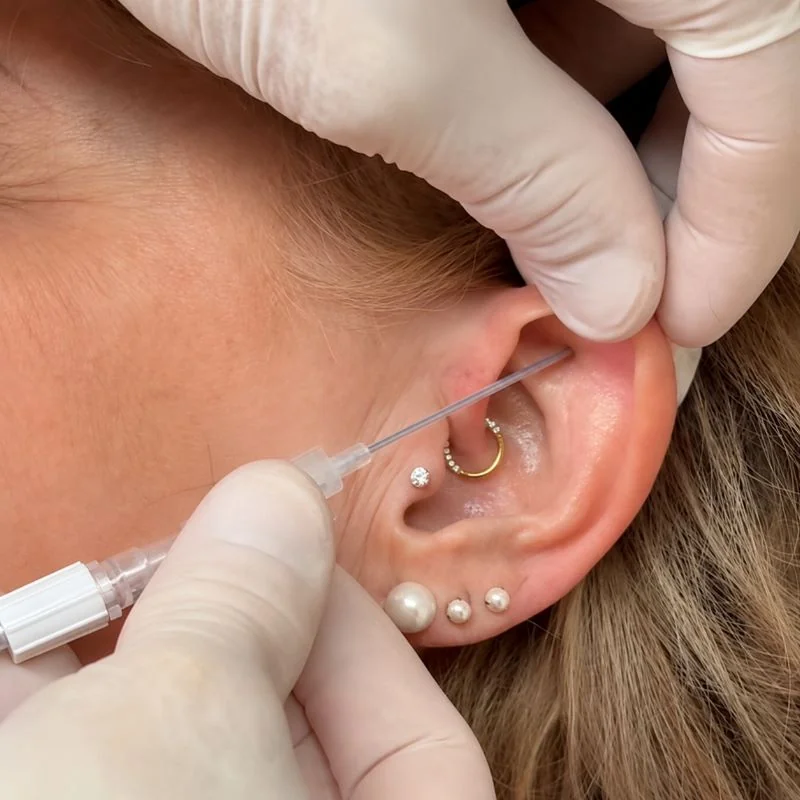
The latest research on the effect of the Daith piercing
Several studies are currently under way to establish whether a piercing placed at a certain point of the ear may help treat migraine and reduce headaches. The research may shed light on the ways in which the piercing may contribute to the success of treatment. If you are also curious about the latest results, stay with me in this article!
Acupuncture may help against migraine
According to research, acupuncture reduces the frequency of migraine attacks. Its effect is similar to that of medicines that help prevent headaches from developing, because the small point where the Daith piercing goes is also known as a migraine pressure point.
The acupuncturist places fine needles at certain points of the body, then stimulates the circulation of the area and nerve function with manual or electrical stimulation. Around the needle concerned, this causes the blood vessels to dilate and increases blood flow to the tissues. It is therefore important that acupuncture is carried out by a highly trained and expert acupuncturist who knows everything about these pressure points.

This is how the Daith piercing works via the vagus nerve
The latest information on stimulating the ear and the vagus nerve comes from a study carried out by the University of Leeds (Bretherton et al., 2019, Aging). Stimulating the outer ear with a mild electrical vibration for 15 minutes a day, for just two weeks, improved the capacity for relaxation and increased the activity of the parasympathetic nervous system. The researchers electrically stimulated a branch of the vagus nerve located in the tragus region. In older people (over 55), the activity of the sympathetic nervous system is stronger, which results in stress, tension, depression and low energy levels. Electrical stimulation in the tragus area brought the nervous system into balance and slowed the physiological effects of ageing. It is important to note that this was a small study, so it is not known whether these results would be the same in a larger controlled study.
The original research took place in the United Kingdom, at the University of Leeds in 2015, with healthy young people. Stimulating the ear with transcutaneous electrical stimulation improved autonomic function in the area of the vagus nerve. Normalising autonomic function means that sympathetic tone decreases, and with it stress, tension and probably vascular tone as well. As a result, the blood vessels do not constrict, and this may help suppress the development of migraine.
The effect of ear therapy on dementia in old age
There is also research in the field of dementia in which the outer area of the ear was temporarily stimulated with mild vibrations. The results suggest that this method may help prevent dementia. Specialists believe that by stimulating the ear, a branch of the vagus nerve can also be reached, and that this is what the positive effect is due to. Similar to what we have assumed so far in the case of the Daith piercing, vagus nerve stimulation is the key factor in this process too.
The Daith piercing and the future
Further research on the effectiveness of the Daith piercing is still under way. Studies are being carried out in England and other European countriesexamining the effectiveness of the method. Whether the Daith piercing will work for someone or not is an entirely individual question. Since migraine can have many triggers, the effectiveness of the Daith piercing probably also depends on whether one of the causes of the migraine is related to the balance of nerve function, and if so, whether it can be corrected by stimulating the vagus nerve. Hopefully, further knowledge will come to light in the near future about vagus nerve stimulation and how these types of headache can best be treated.
The risks of the Daith piercing
The Daith piercing can be risky in several respects. The piercing is pierced into a very sensitive area of the ear, and a single wrong movement can cause lasting damage. It may also happen that it worsens the migraine, which can complicate the situation in the long term.
Other risks of Daith piercings include:
· Infection during healing
· Bacterial infection after healing
· Allergic reaction to the jewellery
· Bleeding
· Nerve damage, including loss of sensation
· Swelling
· Pain
· Scarring defects
You need to know that the wound must be cared for properly and regularly so that no infection or other complication develops.
The Medical Piercing specialists can provide professional help
At Medical Piercing we do everything we can to make sure your jewellery goes in exactly the right place and to prevent complications from developing.
We achieve this as follows:
- We carry out a thorough assessment before the piercing, and check the condition of your ear.
- We carry out pinpoint location.
- On the spot, a piercing made of medical-grade metal, sterilised in an autoclave, is what you get.
- Wearing rubber gloves, in a sterile environment, is how we work.
- We tell you all the important information about caring for the piercing correctly.
- You also receive by e-mail the most important things to know.
- If there is a problem, you can call us, but after 2 weeks we will also contact youto see whether everything is fine with you.
Our wellbeing piercings do not count as a cure and do not replace medical treatment; the description of their effectiveness is based on our guests’ feedback.
Fancy a Daith piercing? The Medical Piercing team is waiting for you! Book through our online calendar, and you can have your piercing within 2–3 days.